In the second year of Donald Trump’s second term as U.S. president, technology has emerged as one of the most influential and controversial pillars of his administration. From artificial intelligence and immigration to data centers, social media, and global trade, Trump’s technology agenda is reshaping how innovation, politics, and power intersect in the modern world. What was once a largely industry-led domain has become a central battlefield for national security, economic dominance, and ideological control.
This article examines the key ways Donald Trump’s administration is redefining technology policy in 2025 and early 2026, and what it means for the future of global tech.
- Immigration and Tech Talent: The H-1B Shock
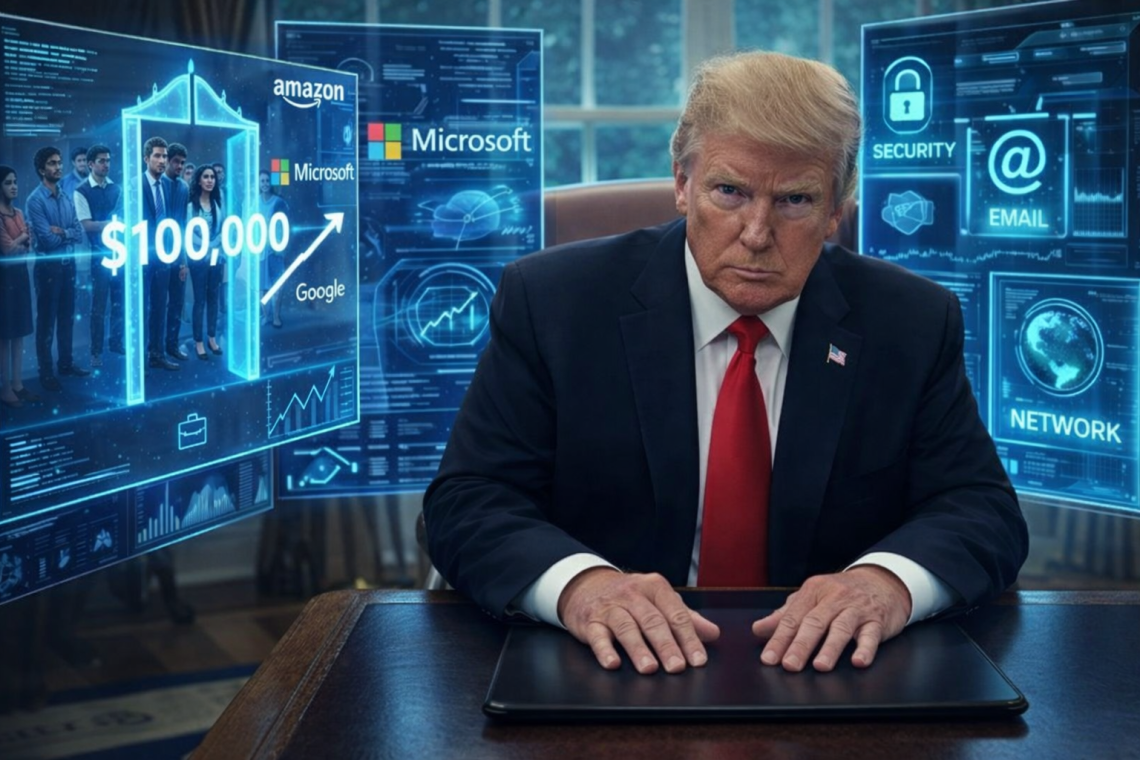
One of the most disruptive changes under Trump’s tech agenda has been the tightening of skilled-worker immigration. The administration introduced sharply increased H-1B visa fees, in some cases reaching tens of thousands of dollars per worker per year. The goal, according to the White House, is to prioritize American labor and reduce dependency on foreign talent.
However, the technology sector has warned that this policy could seriously weaken U.S. competitiveness. Silicon Valley companies have long relied on highly skilled engineers from India, Asia, and Europe to fill advanced technical roles. With higher costs and increased uncertainty, many firms are now relocating research teams abroad or expanding operations in countries with friendlier visa systems.
Economists and analysts describe this trend as a potential brain drain, with top global talent choosing countries like India, Canada, and the UK over the United States. Even some Trump allies in the tech world argue that innovation thrives on global collaboration, not restriction. - Artificial Intelligence: National Strategy Meets Ideology
Artificial intelligence sits at the center of Trump’s technology vision. In mid-2025, the administration launched a sweeping American AI Action Plan, designed to secure U.S. dominance in AI development and deployment. The plan emphasizes rapid innovation, reduced regulation, and massive infrastructure investment.
Key objectives include:
Accelerating domestic AI research
Expanding high-performance computing and cloud infrastructure
Integrating AI into defense, healthcare, and government operations
Competing aggressively with China in advanced technology
At the same time, Trump’s AI strategy has taken a strong ideological turn. The administration has criticized what it calls “politically biased” or “woke AI,” arguing that large language models and algorithms reflect liberal values. Executive orders now require AI systems used by the federal government to meet strict neutrality standards.
Supporters see this as a push for fairness and balance. Critics warn it could politicize AI development, limit academic freedom, and pressure companies to alter training data to satisfy political demands. - Data Centers, Energy, and the Cost of AI
As AI systems grow more powerful, so do their energy demands. Massive data centers now consume enormous amounts of electricity, raising concerns about grid stability, environmental impact, and consumer energy prices.
Trump has taken a hard stance, insisting that big tech companies must pay the full cost of powering their data centers. He argues that ordinary Americans should not subsidize the energy needs of trillion-dollar corporations.
This position has triggered intense debate. Tech companies warn that higher energy costs could slow AI expansion and push infrastructure investment overseas. Supporters counter that tech giants have enjoyed years of low-cost growth and should shoulder more responsibility.
This issue highlights a broader conflict between rapid technological expansion and economic fairness — one that could define the future of AI infrastructure in the U.S. - TikTok and Digital Sovereignty
Few technology issues have captured public attention like TikTok. After years of legal battles and national security concerns, Trump brokered a deal allowing TikTok to continue operating in the U.S. under a newly structured American entity.
The agreement places U.S. investors in control of TikTok’s American operations while introducing strict data-handling requirements. Trump has framed the deal as a victory for national security and American leverage over foreign tech platforms.
Critics remain skeptical, warning that algorithmic influence and indirect foreign control may still exist. Nevertheless, the TikTok deal sets a major precedent: foreign tech companies can access the U.S. market only under strict political and regulatory oversight. - Modernizing Government Tech: The U.S. Tech Force
Recognizing the government’s own technological weaknesses, the Trump administration launched the U.S. Tech Force, a program designed to recruit top engineers and technologists into federal service.
The initiative aims to:
Modernize outdated government IT systems
Strengthen cybersecurity
Integrate AI across federal agencies
Reduce reliance on external contractors
While ambitious, the program faces challenges, including bureaucratic resistance and competition with private-sector salaries. Still, it signals a recognition that technological leadership must begin inside government institutions themselves. - Trade, Tariffs, and Global Tech Competition
Trump’s technology policy is deeply tied to his broader trade agenda. The administration has threatened tariffs and export controls on countries that impose digital taxes on U.S. tech firms or restrict American technology exports.
These measures aim to protect U.S. companies and intellectual property but risk escalating global trade tensions. Allies in Europe and Asia have expressed concern that aggressive U.S. tech nationalism could fragment the global digital economy.
At the same time, Trump’s hardline stance has found support among voters who see technology as a strategic asset that must be defended like energy or defense.
Conclusion: Technology as Power
Donald Trump’s approach to technology is bold, confrontational, and deeply political. His administration treats tech not just as an economic engine, but as a tool of national power, cultural influence, and ideological control.
Supporters argue that this strategy restores American dominance and holds powerful corporations accountable. Critics fear it risks isolating the U.S., slowing innovation, and politicizing science and technology.
What is clear is that under Trump, technology is no longer neutral. It is a central force shaping the future of governance, global competition, and society itself.