
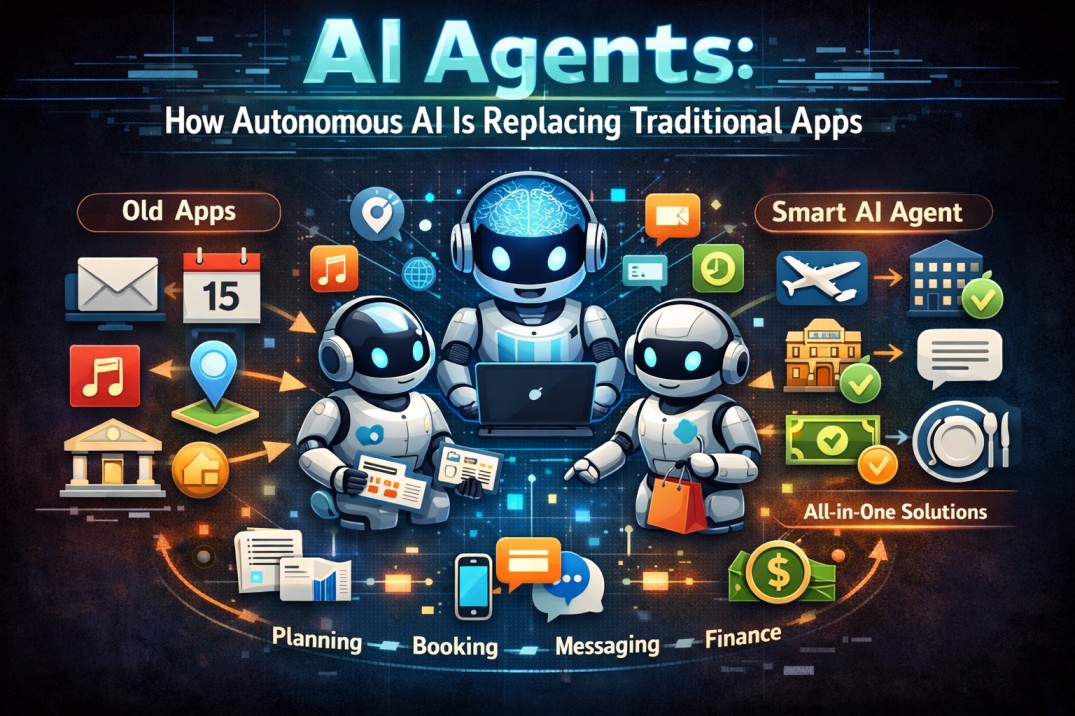
Software has traditionally relied on user interaction—clicks, forms, and manual commands. Whether on mobile or desktop, applications wait for instructions before performing tasks. This model is now changing.
In 2025, AI agents are transforming how digital systems operate. Instead of relying on fixed interfaces, AI agents can independently plan, execute, and manage tasks across multiple platforms. As a result, traditional applications are gradually being replaced by intelligent, goal-driven systems.
What Are AI Agents?
AI agents are autonomous software programs designed to perform tasks without continuous human input. They are capable of:
Understanding user goals
Making decisions based on context
Executing multi-step actions
Integrating with external tools and services
Unlike standard AI features embedded in apps, AI agents operate independently and adapt over time.
How AI Agents Differ From Traditional Apps
Traditional applications are built around predefined features and user interfaces. AI agents, on the other hand, focus on outcomes.
Key differences include:
Apps require manual operation; AI agents act autonomously
Apps perform specific functions; AI agents manage complete workflows
Apps rely on interfaces; AI agents use natural language commands
This shift removes the need to manage multiple applications for related tasks.
Why AI Agents Are Replacing Traditional Apps
- Unified Task Execution
Instead of using separate apps for communication, data entry, and reporting, AI agents can complete entire processes end-to-end. A single instruction can trigger multiple actions across different systems. - Natural Language as the Interface
AI agents eliminate complex dashboards. Users interact through simple language such as:
“Generate last week’s sales summary and email it to management.”
The agent determines how the task is completed. - Adaptive and Personalized Workflows
Traditional apps offer static experiences. AI agents learn from user behavior, improving efficiency and accuracy over time. This creates a personalized software experience without manual configuration. - Reduced Dependence on Multiple SaaS Tools
Businesses are increasingly replacing multiple subscriptions with AI agents that can handle:
Customer inquiries
Order processing
Inventory tracking
Data analysis
This approach lowers operational costs and simplifies management. - Cross-Platform Integration
AI agents can connect email services, analytics tools, e-commerce platforms, and payment systems without custom development. This flexibility allows businesses to scale faster.
Practical Use Cases
Customer Support
AI agents manage common requests such as order tracking, refunds, and FAQs, providing consistent responses and escalating complex cases when needed.
E-commerce Operations
Online stores use AI agents to update product listings, monitor stock levels, respond to customers, and optimize pricing automatically.
Content and Digital Marketing
AI agents assist with content creation, SEO optimization, publishing schedules, and performance analysis—reducing reliance on multiple marketing tools.
Business Analytics
Instead of navigating dashboards, decision-makers can request insights directly. AI agents collect, analyze, and summarize data in clear language.
Challenges and Considerations
Despite their benefits, AI agents introduce new challenges:
Data privacy and compliance risks
Accuracy and reliability concerns
Need for human oversight
Regulatory uncertainties
Organizations must implement controls to ensure responsible use.
Impact on Software and Employment
AI agents are not eliminating software; they are redefining it. Development is shifting from building standalone apps to designing intelligent systems. Jobs focused on repetitive tasks are declining, while roles centered on strategy, supervision, and system design are increasing.
The Future of Digital Software
Software is moving away from feature-based applications toward goal-oriented intelligence. In the coming years:
Users will rely less on individual apps
AI agents will serve as central digital operators
Productivity will depend on outcomes, not interfaces
Conclusion
AI agents represent a fundamental evolution in technology. By replacing rigid applications with autonomous systems, they simplify operations, reduce costs, and improve efficiency.